|
The battleship U.S.S. Nevada joined the Atlantic Fleet at Newport, Rhode Island on May 26, 1916, following shakedown and gunnery trials. She was engaged in gunnery exercises near Guantanamo Bay, Cuba when the United States entered World War I and spent the first months of the war training prospective destroyer crews and serving as a gunnery training ship until August of 1918. Nevada was then assigned to the Sixth Battle Squadron of the British Grand Fleet, arriving in Bantry Bay, Ireland, on August 13, 1918. Nevada and the other ships of the Sixth Battle Squadron provided convoy escort and patrol duties but saw no combat action during the remainder of the war and Nevada was soon part of the escort for American transport George Washington carrying President Woodrow Wilson to France for the Paris Peace Conference.
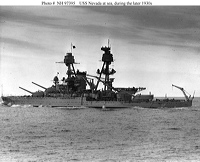
Between the end of World War I and 1929, Nevada served in the usual fleet exercises, battle problems and tours “showing the flag” in South America, Europe and Australia. Nevada was modernized at the Norfolk Naval Shipyard during 1930 - 31, spending the next ten years mostly in the Pacific Fleet. On December 7, 1941 Nevada was moored aft of the Arizona and was the only battleship to get underway during the Japanese attack, despite and early hit by a torpedo in the port bow. Being underway, she became a prime target of the attacking Japanese aircraft, taking several bomb hits which set her afire before she ran aground near Hospital Point. Several tugs assisted her in backing across the main channel, where she was deliberately grounded stern first at Waipio Point and eventually salvaged. Fifty men were killed and 109 wounded on Nevada.
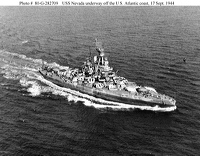
Nevada was refloated and sent to the Puget Sound Naval Shipyard for repairs and modernization, which included modifying the superstructure, new radars, 8 - twin 5" guns and many 40mm and 20 mm guns. By 1943, Nevada was serving as a gunfire support ship for the capture of Attu Island in the Aleutians. Following that action, Nevada returned to the Atlantic for the invasion of France on June 6, 1944, gaining a reputation there as an excellent gunnery ship. Normandy was followed by duty in Southern France and then back to the Pacific in time for operations against Iwo Jima and Okinawa. During the Okinawa operation, Nevada was hit by a kamikaze and also by shore batteries, killing or wounding 78 men but suffering no crippling damage.
Following the war, Nevada was selected to serve as the “ground zero” target during the Operation Crossroads atomic tests of 1946. Partially stripped and painted a bright orange, Nevada survived both atomic blasts, though badly damaged topside. She was taken to Pearl Harbor for evaluation and tests primarily involving radioactive decontamination methods, none of which were particularly successful. Nevada was sunk as a target by bombs and torpedoes off Hawaii in 1948. (DBoyer 2007)
|