|
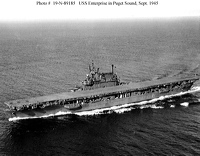
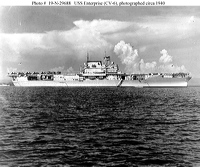
The aircraft carrier U.S.S. Enterprise saw more combat in World War II than any other major warship and was, without question, the most destructive fighting ship in history. Enterprise was also the only ship of her class to survive the war and her twenty battle stars, the most of any U.S. naval vessel, began with Pearl Harbor. Enterprise was just hours from berthing at Pearl on December 7, 1941 and nine of her aircraft were combat losses that day, seven to friendly fire. While patrolling off Hawaii on December 10th, Enterprise aircraft sank the Japanese submarine I-70, the first Japanese warship lost to U.S. forces in World War II. Enterprise began 1942 with a series of raids on the Marshall Islands, Wake and Marcus, honing her combat air crews and flight deck crews and inflicting damage on the enemy, disrupting their timetable for conquest.
Enterprise’s next operation, in April of 1942, was providing combat air patrol for the carrier Hornet as that ship delivered Colonel Doolittle’s B-25s on their famous raid on Tokyo. This action prevented Enterprise from making the Battle of the Coral Sea, the only major action she missed during the war. She more than made up for this lapse at the Battle of Midway, 4 - 6 June, where her aircraft destroyed Akagi and Kaga, the two largest carriers in the Japanese navy and shared credit for sinking Hiryu. At the end of this battle, four of the six aircraft carriers that had attacked Pearl Harbor were on the bottom and so was Yorktown. By July, Enterprise was in the Solomons, supporting the Guadalcanal operations and helping sink a battleship and a heavy cruiser. Severely damaged by bombs twice in the carrier battles that raged throughout that year, Enterprise lost 118 men killed and 173 wounded in these actions. Returning to Pearl Harbor for refit, Enterprise received the first Presidential Unit Citation awarded to an aircraft carrier on May 27, 1943. Enterprise then went to Bremerton for overhaul, including a massive increase in AA armament, firefighting capabilities and new radars and combat centers that made her an even more effective warship.
Returning to combat in November 1943, Enterprise operated with the fast carrier task forces beginning with Makin, then Kwajalein in January 1944, followed by raids on Truk in February where her aircraft conducted the first night radar attack. Through 1944, Enterprise participated in attacks on Palau, the Marianas, the Volcano and Bonin Islands, Palau again and the Philippines invasion in October. Operating primarily as a night carrier, Enterprise supported the invasions of Iwo Jima and Okinawa in February - April 1945, then raids on Tokyo in late April and back to Okinawa in May. On May 14, 1945, a Zero aircraft crashed through Enterprise’s flight deck, killing 14 and wounding 34 men. Fully repaired by the end of the war, Enterprise decommissioned in1946. Considerable efforts were made to preserve her as a memorial, but an indifferent navy did not help, and she was finally scrapped at Kearny, NJ in July 1958. (DBoyer 2007)
|